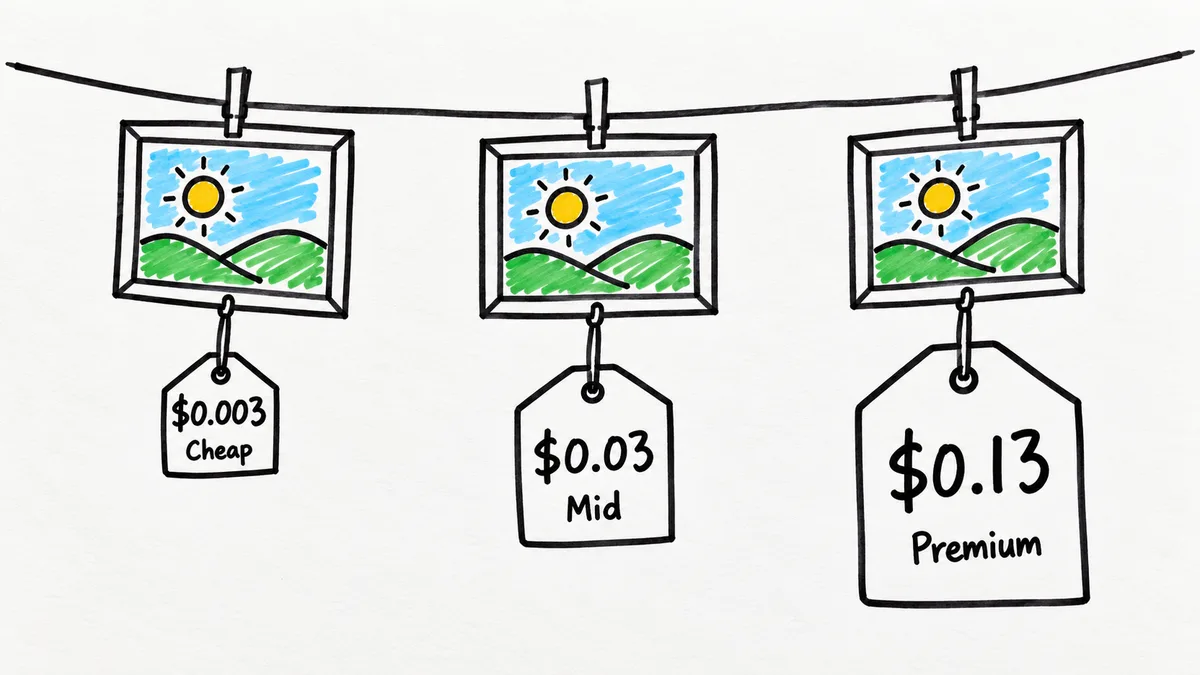
If you are searching for the cheapest image generation API, you will find a mess. Every provider counts a different way: per image, per megapixel, per million tokens, in credits, or by the second of GPU time. One page says an image costs half a cent, another says thirteen cents, and both can be right.
This guide puts them on one scale: what one 1024 x 1024 image costs, and what 1,000 or 10,000 of them cost. We read the official pricing pages in October 2026, flagged what we could not confirm, and kept vendor claims separate from facts.
Why "cheapest" is harder than it sounds#
Image APIs charge in at least five ways:
- Per image: a flat price for each picture (Recraft, Stability, Gemini).
- Per megapixel: the price scales with the size of the picture (FLUX on Together and fal).
- Per token: you pay for the tokens the model produces, and quality or size changes the count (OpenAI GPT Image 2 and 2.5).
- Per credit: a currency you buy up front, such as Stability's 1 credit = $0.01.
- Per second of compute: you pay for GPU time, so a slow model costs more (Replicate for many models).
So a fair comparison needs one yardstick. We use one 1024 x 1024 image (about 1 megapixel). Where a provider only lists another size, we say so.
The price list: cost per image, cheapest first#
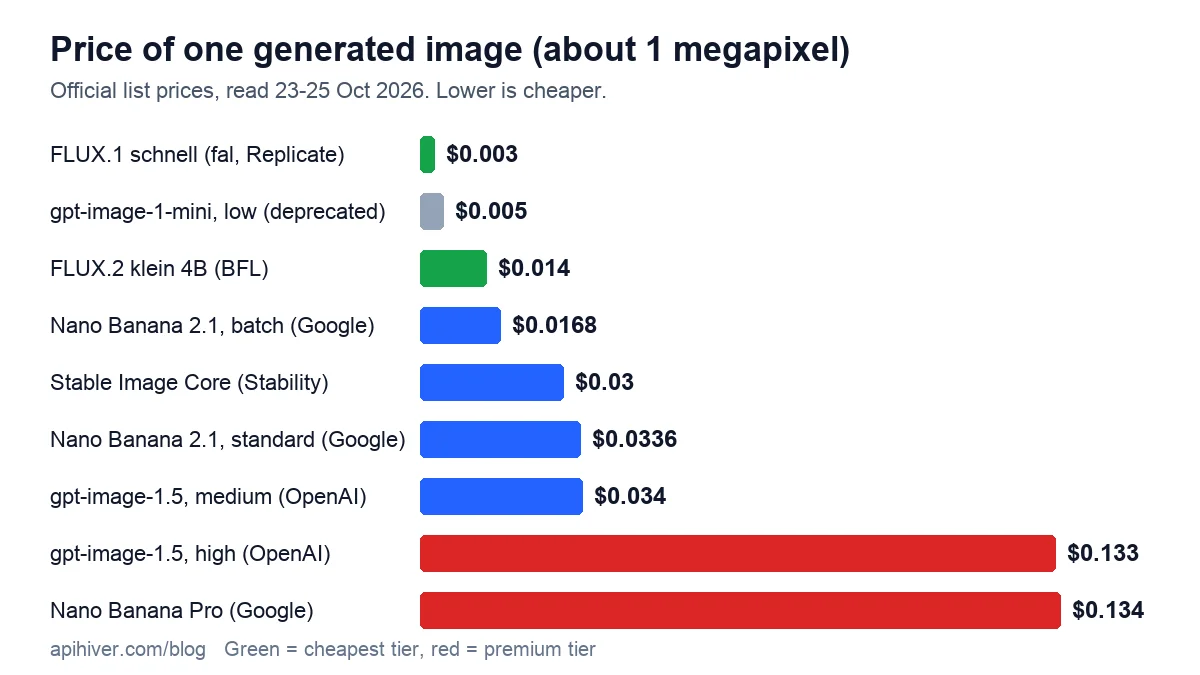
All prices are the standard pay-as-you-go prices we saw on the provider's own page between 23 and 25 October 2026. Prices change often.
| API and model | Price per image | Billed by | Our notes |
|---|---|---|---|
| Runware, FLUX 3 Image Klein | $0.003 | Image | Listed at 512 x 512, 16 steps |
| fal, FLUX.1 [schnell] | $0.003 | Megapixel | About $0.003 for 1 MP |
| Replicate, flux-schnell | about $0.003 | Image | Listed as $3.00 per 1,000 images |
| fal, Z Image Turbo | $0.005 | Megapixel | |
| OpenAI, gpt-image-1-mini (low) | $0.005 | Image | Deprecated, shuts down 1 Dec 2026 |
| Runware, Recraft V4.1 Flash | $0.007 | Image | |
| OpenAI, gpt-image-1.5 (low) | $0.009 | Image | Marked deprecated on OpenAI's model page |
| BFL, FLUX.2 [klein] 4B | $0.014 | Image | Open weights, Apache 2.0 |
| Google, Nano Banana 2.1 (batch, 1K) | $0.0168 | Image | Half-price batch mode |
| Stability, SD 3.5 Flash | $0.025 | Credits | 2.5 credits |
| Stability, Stable Image Core | $0.03 | Credits | 3 credits |
| BFL, FLUX.2 [pro] | about $0.03 | Megapixel | $0.03 per MP |
| Google, Nano Banana 2.1 (standard, 1K) | $0.0336 | Image | |
| OpenAI, gpt-image-1.5 (medium) | $0.034 | Image | |
| Recraft, V4 raster | $0.04 | Image | Vector costs $0.08 |
| Google, Nano Banana 2 (standard, 1K) | $0.067 | Image | |
| OpenAI, gpt-image-1.5 (high) | $0.133 | Image | |
| Google, Nano Banana Pro (1K or 2K) | $0.134 | Image | $0.24 at 4K |
A note on sources: aggregator sites such as Price Per Token list even lower figures (for example $0.0002 for SDXL Turbo). We left those out of the main table because they come from a third party that converts every provider to one unit, and we could not confirm each one on the hosting provider's page. They show that the floor is well under a cent for small open models.
What it costs at 1,000, 10,000 and 100,000 images#
Price per image looks tiny until you multiply. Here is the same list as a monthly bill.
| Option | 1,000 images | 10,000 images | 100,000 images |
|---|---|---|---|
| FLUX.1 schnell (fal or Replicate) | $3 | $30 | $300 |
| gpt-image-1-mini, low (deprecated) | $5 | $50 | $500 |
| FLUX.2 [klein] 4B | $14 | $140 | $1,400 |
| Nano Banana 2.1, batch, 1K | $16.80 | $168 | $1,680 |
| Stability SD 3.5 Flash | $25 | $250 | $2,500 |
| Stable Image Core | $30 | $300 | $3,000 |
| Nano Banana 2.1, standard, 1K | $33.60 | $336 | $3,360 |
| gpt-image-1.5, medium | $34 | $340 | $3,400 |
| gpt-image-1.5, high | $133 | $1,330 | $13,300 |
| Nano Banana Pro, 1K | $134 | $1,340 | $13,400 |
This is plain multiplication of the list prices above, with no free tier, discount or retries counted. At 100,000 images a month, the gap between the cheapest and the priciest option is more than $13,000.
The cheapest from the big labs#
If you want a model from a large company with a stable roadmap, your options are narrower and the prices are higher.
Google: Nano Banana 2.1 and 2 Lite#
Google's pricing page lists Nano Banana 2.1 (gemini-nano-banana-2.1) at $0.0336 for a 1K image, $0.0504 at 2K and $0.113 at 4K. Batch mode halves each of those, so 1K drops to $0.0168. Nano Banana 2 Lite (gemini-3.1-flash-lite-image) is listed at the same $0.0336 for 1K, with a $0.0168 batch price.
Three things to know:
- The page lists no free tier for any image model.
- The original Nano Banana (
gemini-2.5-flash-image) is marked deprecated, with a shutdown date of 2 October 2026. Do not start on it. - Imagen is gone from the Gemini API. Google's Imagen page says it is "now shut down" and recommends Nano Banana. If a tutorial still shows
generate_images, it is out of date.
OpenAI: cheap options are on the way out#
OpenAI's current models, gpt-image-2 and the gpt-image-2.5 family (flare and sunburst), are billed by tokens: $30 per million image output tokens, $8 per million image input tokens and $5 per million text input tokens. OpenAI's pricing page says to use the calculator in its image guide for per-image estimates, and the interactive calculator did not load for us, so we cannot give you an official per-image figure for these models. One third-party host, Together AI, lists GPT Image 2 at $0.053 per image. Treat that as a hint, not OpenAI's number.
The per-image prices we can quote are for older models, and both are on a deprecation clock:
| Model | Low | Medium | High | Status |
|---|---|---|---|---|
| gpt-image-1-mini (1024 x 1024) | $0.005 | $0.011 | $0.036 | Shuts down 1 Dec 2026 |
| gpt-image-1.5 (1024 x 1024) | $0.009 | $0.034 | $0.133 | Marked deprecated, no date on the page |
OpenAI's Batch API takes 50% off the token prices of every image model on its pricing page. If you use gpt-image-1, it shuts down on 23 October 2026, which was two days ago. See our gpt-image-1 migration guide.
The cheapest overall: open-weight models on hosting platforms#
The lowest prices belong to small, fast open-weight models, mainly FLUX.1 schnell, that platforms host for you.
| Platform | Cheapest image model we found | Price |
|---|---|---|
| Runware | FLUX 3 Image Klein (512 x 512) | $0.003 |
| fal | FLUX.1 [schnell] | $0.003 per megapixel |
| Replicate | flux-schnell | $3.00 per 1,000 images |
| fal | Z Image Turbo | $0.005 per megapixel |
| Together AI | FLUX.2 [dev] | $0.0154 per image |
| Cloudflare Workers AI | FLUX.1 schnell | about $0.0006 (our estimate) |
Runware says you are "only charged for successful API requests that generate outputs," which matters when some requests fail. It also lists Recraft V4.1 Flash at $0.007 and Ideogram 4.5 at its lowest setting for $0.008.
fal bills most diffusion models per megapixel and newer flagship models per image. Its pricing page lists FLUX.1 schnell at $0.003 per megapixel and Nano Banana 2 at $0.08 per image, which is higher than Google's own $0.067 for 1K.
Replicate bills many models by run time, so cost depends on hardware and how long the model runs. Its page lists flux-dev at $0.025 and flux-1.1-pro at $0.04 per image.
Together AI lists FLUX.2 [pro] at $0.03 and FLUX.2 [dev] at $0.0154 per image. We did not find FLUX.1 schnell on its image price list.
Cloudflare Workers AI charges $0.011 per 1,000 Neurons above a free allowance. For FLUX.1 schnell its page lists $0.0000528 per 512 x 512 tile and $0.0001056 per step. If you assume a 1024 x 1024 image is four tiles and uses four steps, that comes to roughly $0.0006 per image. That is our arithmetic, not a price Cloudflare publishes, so check the unit rules before you rely on it.
Black Forest Labs and Stability, direct#
Going straight to the model makers costs more than the cheapest hosts:
- Black Forest Labs (FLUX): FLUX.2 [klein] 4B is $0.014 and 9B is $0.015. FLUX.2 [pro] is $0.03 per megapixel, [flex] is $0.05 and [max] is $0.07. BFL's help page lists these prices, but its docs page showed blank price cells when we read it, so confirm on the BFL calculator.
- Stability AI: 1 credit is $0.01. SD 3.5 Flash is 2.5 credits ($0.025), Stable Image Core 3 credits ($0.03), SD 3.5 Medium 3.5 credits ($0.035), SD 3.5 Large Turbo 4 credits ($0.04), SD 3.5 Large 6.5 credits ($0.065) and Stable Image Ultra 8 credits ($0.08). New accounts get 25 free credits.
- Recraft: V4 and V3 raster images are $0.04, vector $0.08, and the Pro tiers are $0.25 and $0.30.
Free image generation APIs and free credits#
There is no free image API you can safely run a business on, but you can get started for nothing.
| Option | What you get | Catch |
|---|---|---|
| Cloudflare Workers AI | 10,000 Neurons a day at no charge, reset at 00:00 UTC | Needs an account; about 170 FLUX schnell images a day by our estimate |
| Stability AI | 25 credits on signup (about 8 Core images) | One-time |
| Runware | $2 in free credits for sign-ups with a business email | One-time, business email only |
| Hugging Face PRO | $2 of included inference credits each month | Needs a paid PRO plan |
| Pollinations | Returned an image without a key in our test | Docs now say a key is required; the image had a watermark |
We tested the Pollinations keyless URL on 25 October 2026. It returned a 512 x 512 JPEG with HTTP 200, and the picture carried a Pollinations logo even though we asked for none. The provider's current guide says API calls need a key, so the keyless URL could stop working at any time. Use it to experiment, not to ship.
OpenAI, Google and fal list no free image tier on the pages we read.
What happened to the DALL-E 2 API#
Searches for "DALL-E 2 API" are growing, so here is the plain answer: it no longer exists. OpenAI's deprecations page lists both dall-e-2 and dall-e-3 with a shutdown date of 2026-05-12, announced on 14 November 2025. A call to either model now fails.
OpenAI recommends gpt-image-2, gpt-image-1 or gpt-image-1-mini as replacements. Two of those have since been scheduled for shutdown (23 October and 1 December 2026), so the practical replacements are gpt-image-2 and the gpt-image-2.5 models. If you used DALL-E 2 because it was cheap, look at the open-weight options above, which are cheaper still.
What makes a cheap API cost more#
The price per image is only part of your bill.
- Retries. If a cheap model needs three attempts to produce a usable image, it costs three times the list price. Ask whether the provider charges for failed or moderated requests (Runware says it does not charge for failed requests).
- Resolution. Megapixel pricing scales with size. A 2 MP image costs about double a 1 MP image on most per-megapixel plans, and Google's 4K price for Nano Banana 2.1 is more than three times its 1K price.
- Editing costs more than generating. BFL lists FLUX.2 [pro] editing at $0.045 per megapixel against $0.03 for text-to-image.
- Token billing is variable. With OpenAI's newer models you pay for tokens, so the same prompt can cost different amounts at different quality settings.
- Model shutdowns. OpenAI retired DALL-E and Google retired Imagen in 2026. Rewriting your code costs developer time.
- Storage and bandwidth. You will want to save every image yourself rather than regenerate it. See our production guide.
How to cut your image bill#
- Generate drafts at low quality or small size, then upscale only the winners.
- Use Batch mode (50% off at OpenAI and Google) for anything that is not live.
- Cache and store every image. Never regenerate the same prompt twice.
- Ask for one image per request until you know your approval rate.
- Set a hard monthly spending limit in the provider dashboard.
- Keep a second, cheaper provider for non-critical jobs such as thumbnails.
- Re-check prices every quarter. They change often.
Which one should you pick?#
| Your situation | Start with | Why |
|---|---|---|
| Cheapest possible, quality is secondary | FLUX.1 schnell on fal, Replicate or Runware | About $0.003 an image |
| Cheap, from a large company | Google Nano Banana 2.1 | $0.0336, or $0.0168 in batch |
| Need readable text in images | A higher OpenAI or Google tier | Cheap models struggle with text |
| Predictable flat price, no GPU math | Stability Core or Recraft V4 | $0.03 to $0.04 per image |
| Just trying it out | Cloudflare free allowance or Stability's 25 credits | No card needed to start |
| A live product with real users | Read the production guide first | Reliability beats price |
Compare these against quality, not just price, in our roundup of the best AI image generation APIs.
Key takeaways#
- The cheapest listed price is about $0.003 per 1 MP image, from FLUX.1 schnell on fal and Replicate and FLUX 3 Image Klein on Runware.
- Google Nano Banana 2.1 is the cheapest big-lab option at $0.0336 (batch $0.0168).
- OpenAI's cheap models, gpt-image-1-mini and gpt-image-1.5, are deprecated.
- DALL-E 2 and DALL-E 3 shut down on 12 May 2026.
- The top end costs about 44x the bottom end, so match the model to the job.
- Batch mode halves the price at OpenAI and Google.
- Test quality on your own prompts before you pick on price.
Sources we read#
We read these pages between 23 and 25 October 2026. Prices change, so check each provider's own page before you commit.
OpenAI (5): Pricing, Deprecations, gpt-image-1.5 model page, gpt-image-1-mini model page, Image generation guide.
Google (2): Gemini API pricing, Imagen page.
Model makers (4): Stability AI pricing, Black Forest Labs pricing, BFL help center, BFL docs pricing.
Hosting platforms (6): fal pricing, Together AI pricing, Runware pricing, Replicate pricing, Cloudflare Workers AI pricing, Hugging Face pricing.
Other (4): Recraft API pricing, Ideogram pricing, Pollinations API guide, Price Per Token: cheapest image models.
The Ideogram API prices did not load for us, so we did not list them. The BFL docs page showed blank price cells, so we used BFL's help center page for FLUX prices. Third-party pages such as Price Per Token are aggregators and we used them only to describe the price floor. We did not run API calls against paid providers and did not compare image quality, so treat this as a price guide, not a quality ranking.