If you are searching for a flight booking API, the first thing to know is that many "flight APIs" cannot book anything. Some show prices, some track planes, and only a few can take a passenger's name, charge a card and return an airline booking reference. In 2026 the list of ones you can actually start using also got shorter, because Amadeus closed its Self-Service portal on 17 July 2026.
This guide compares 10 famous flight APIs on the one question that matters: can this API book a ticket, and how hard is it to get access? Each option has its price, access route, strengths and limits, based on the providers' own pages and documentation.
Flight booking API comparison table#
We read each provider's own pages where they loaded, and reseller or review pages where they did not. "Can book?" means the API can create a ticket order for your customer, not just show prices.
| API | Can book? | How you get access | Cost model (as published) |
|---|---|---|---|
| Duffel | Yes | Self-serve, test token in dashboard | $3.00 per order, no minimums stated |
| Amadeus Enterprise | Yes | Sales contract (Self-Service closed 17 Jul 2026) | Commercial agreement |
| Sabre | Yes | Account activation, certification | Commercial agreement |
| Travelport | Yes (GDS and NDC) | Provisioning by Travelport and each airline | Commercial agreement |
| Kiwi.com Tequila | Yes | Approved B2B partners only since May 2024 | Revenue share on bookings |
| Skyscanner | No, sends users to book | Partner approval, about two weeks | Partner agreement |
| Travelpayouts | No, affiliate links | Register for a token | Free, you earn commission |
| SerpApi Google Flights | No, gives a booking token | Sign up for an API key | Paid plans, cached results free |
| Aviationstack | No, flight data | Self-serve | Free 100 requests/month, paid from $49.99 |
| FlightAware AeroAPI | No, tracking data | Self-serve | Pay per query, tiers from $0 to $1,000/month minimum |
How a flight booking API works#
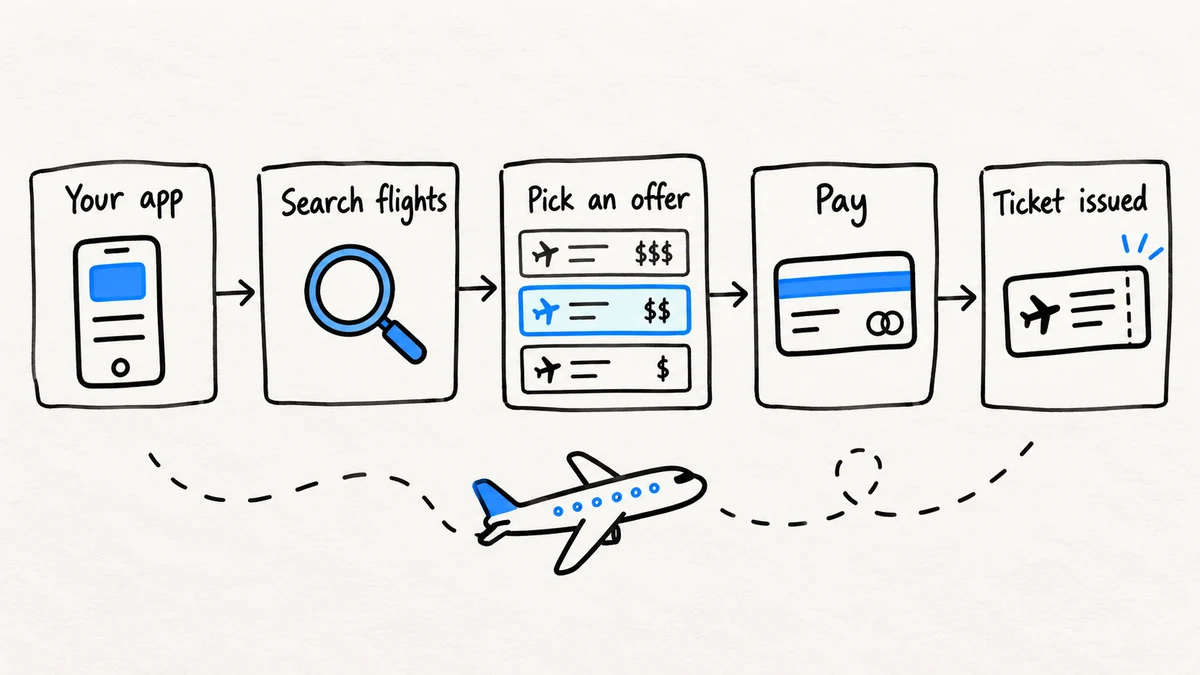
Every flight booking API follows the same four steps, even when the names differ:
- Search. You send an origin, destination, dates and passengers. You get back a list of offers.
- Pick and refresh. The customer picks an offer. You ask the API for the offer again, because prices and seats go stale quickly.
- Pay. You collect money from the customer, then pass the payment details to the API.
- Order. You send passenger names and details. The API returns the airline's booking reference.
The sketch at the top of this post shows that flow. Duffel's guide uses exactly these steps, and it warns that offers get stale fairly quickly and then can no longer be booked.
1. Duffel: the easiest flight booking API to start with#
Duffel is an aggregator. One API connects you to several airline sources, and you do not need your own airline contracts to start.
What it can do: search, offer refresh, payment, order creation, bags and other extras, changes and cancellations. Duffel's getting-started guide walks through offer requests, offers and orders with the endpoints named.
What it costs: Duffel's pricing page lists:
- $3.00 per confirmed order
- $2.00 per paid extra (ancillary)
- 1% of order value for Managed Content, which uses Duffel's IATA accreditation
- 2% on the exchange rate when currency conversion is needed
- $0.005 per search above 1,500 searches per order
With 10 orders in a month you get 15,000 free searches, and at 25,000 searches the extra fee is $50, according to Duffel's own example. A rough example we calculated: 100 orders a month at $3 is $300 in fees, plus 1% of what customers spend on Managed Content.
Watch out for: Duffel's own comparison page says its fares are on average more expensive than direct airline fares. Check whether that fits your margins. Duffel's page also mentions legal notices that must be shown at checkout.
Here is the flow in code. It follows the method names in Duffel's guide, but we have not run it against a live account, so test it with your own token first:
import { Duffel } from '@duffel/api'

const duffel = new Duffel({ token: process.env.DUFFEL_TOKEN })

// 1. Search
const request = await duffel.offerRequests.create({
  slices: [{ origin: 'LHR', destination: 'JFK', departure_date: '2026-12-01' }],
  passengers: [{ type: 'adult' }],
  cabin_class: 'economy',
})

// 2. Refresh the chosen offer right before paying
const offer = await duffel.offers.get(request.data.offers[0].id)

// 3 and 4. Charge your customer first, then create the order
const order = await duffel.orders.create({
  selected_offers: [offer.data.id],
  payments: [{
    type: 'balance',
    currency: offer.data.total_currency,
    amount: offer.data.total_amount,
  }],
  passengers: [{
    id: request.data.passengers[0].id,
    title: 'mr', given_name: 'Ada', family_name: 'Lovelace',
    born_on: '1990-01-01', gender: 'm',
    email: '[email protected]', phone_number: '+442080160509',
  }],
})
console.log(order.data.booking_reference)
2. Amadeus: Self-Service is closed, Enterprise remains#
Amadeus used to be the default answer for developers. In February 2026 it told users it would pause new registrations and decommission the self-service part of its developer portal, and on 17 July 2026 the keys were disabled. PhocusWire and several developer guides report this, and a developer portal notice confirms it.
The Enterprise APIs are not affected, but they need a commercial agreement and, according to one migration guide, significantly higher costs. So for a new project, Amadeus is now a sales conversation, not a sign-up form.
Pick it if: you are a travel company with volume and a budget. Skip it if: you are building an MVP.
If you hit a tutorial that starts with an Amadeus test key, see our note on outdated API tutorials.
3. Sabre#
Sabre's Bargain Finder Max searches for 50, 100 or 200 low-fare options and can shop private fares, according to Sabre's documentation. The version 1 docs say new users should use the newest version, version 4, and that the service requires activation through your Sabre account representative.
Sabre is usually described as stronger in North America, though one comparison puts it at around 400 airlines against Amadeus at 700 or more. Those counts come from vendor blogs and disagree between sources.
Pick it if: you have, or can get, a Sabre agreement. Expect certification before live inventory. One comparison estimates direct access to any of the big three GDS systems can take six to fourteen months.
4. Travelport#
Travelport serves GDS content and NDC content through the same search call. Its guide says to include "NDC" in the content source list, otherwise only GDS content comes back. NDC offers are marked with the airline's code instead of Travelport.
Two caveats from its own guide: NDC is shopping-led, so inventory and price are not guaranteed until booking is completed, and you must be provisioned by both Travelport and every participating airline.
Pick it if: you need both GDS breadth and direct airline content, and you have a commercial relationship.
5. Kiwi.com Tequila#
Tequila is known for multi-city routing, "nomad" searches and virtual interlining, which stitches together airlines that have no partnership with each other. A reseller's page says Kiwi limited Tequila to B2B partners in May 2024 and closed self-serve key registration. Some older guides still describe it as free to register, so treat those as outdated.
Duffel's marketing page claims Tequila adds up to 50% markup on bags and seats and charges 10 to 30 euros for refunds. That is a competitor's claim, so verify it with Kiwi before you decide.
Pick it if: you have a live travel product and want complex routes, and you can pass partner review.
6. Skyscanner#
Skyscanner is the famous name, but it is a metasearch partner API. It returns live and indicative prices, and users book with the airline or travel agent. Access is manual: one review page says approval takes about two weeks and covers established partners.
Read the caching rule before you build. The same page states that caching price data is forbidden, yet also describes indicative prices for browse pages, so confirm the exact terms with Skyscanner. We cover access in more detail in our Skyscanner API documentation guide.
Pick it if: you run a search site with traffic and can wait for approval.
7. Travelpayouts (Aviasales data)#
Travelpayouts gives you flight price data and affiliate links. You do not pay per call. You earn commission when users book through your links. Its Aviasales data endpoint returns tickets that users found in the last 48 hours, and it advises you to cache results because of per-minute rate limits.
Pick it if: you run a deals or "best time to fly" content site. Skip it if: you need live prices or your own checkout.
8. SerpApi Google Flights#
Google does not offer a public flight API. SerpApi fills the gap by returning Google Flights results as JSON, including best and other flights, price insights and a booking token. Parameters cover route, dates, passengers, cabin, stops, airlines and currency.
Round trips need a second request using a departure token. Cached results last one hour and do not count toward your monthly searches. Read our guide to the Google Flights API for the legal and practical limits.
Pick it if: you want Google's prices in your tool. It does not issue tickets.
9. Aviationstack#
Aviationstack returns real-time flight data. Its free plan gives 100 requests a month and is listed for non-commercial use only. Paid plans are $49.99 a month for 10,000 requests, $149.99 for 50,000 and $499.99 for 250,000, with lower prices when billed yearly.
Pick it if: you need flight status in an app. It cannot sell a ticket.
10. FlightAware AeroAPI#
AeroAPI is built for tracking. It has three tiers: Personal with no minimum and up to $5 a month in free usage, Standard with a $100 monthly minimum and Premium with $1,000. Prices are per result set of 15 records, for example $0.005 for flight information and $0.050 for a flight search.
Volume discounts rise from 30% off after the first $1,000 a month up to 94% off above $64,000.
Pick it if: you need accurate tracking and predicted arrival times. It is not a booking tool.
GDS vs NDC vs aggregator: what these words mean#
- GDS (Sabre, Travelport, Amadeus): one connection, hundreds of airlines, mature servicing. One vendor comparison puts per-segment fees at $3 to $15.
- NDC: an airline data standard for richer offers and extras. The same source says it covers roughly 77 airlines, about 20% of IATA members. The figures come from a software firm that sells integrations, so use them as a rough guide.
- Aggregator (Duffel): one simple API over several sources. Easier to start, but check servicing limits.
Many teams end up mixing: a GDS for breadth, direct or NDC links for big airlines and an aggregator for the rest.
Which flight booking API should you choose?#
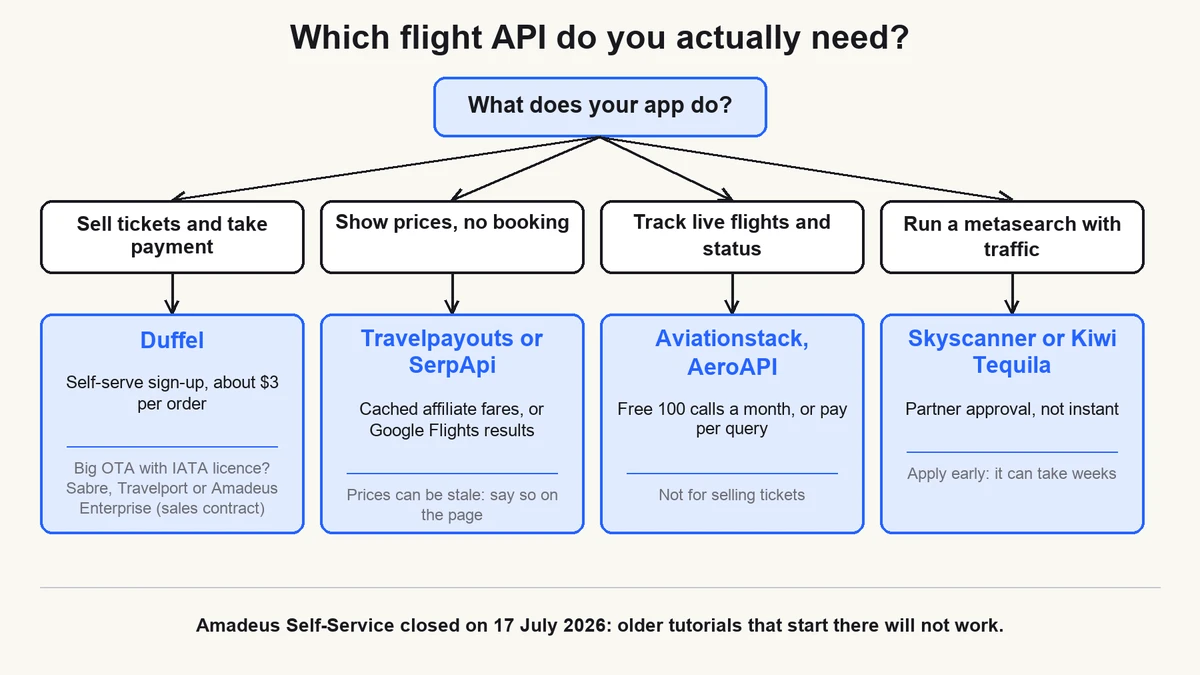
- Selling tickets, small team: Duffel.
- Large agency with an IATA licence: Sabre, Travelport or Amadeus Enterprise.
- Complex multi-city routes, existing traffic: apply to Kiwi Tequila.
- Search site with traffic, no booking: Skyscanner partners.
- Deals and content site: Travelpayouts.
- Price display in a tool: SerpApi.
- Flight status or tracking: Aviationstack or FlightAware AeroAPI.
Other options we looked at: AeroDataBox (cheap data, free tier of 600 units a month on RapidAPI), OpenSky (free position data only) and the Lufthansa Open API, where registration shows as on hold until further notice. Older roundups, such as Nordic APIs' 2023 list, also name Expedia, Kayak and TripAdvisor. Those are mostly partner-only or lodging and review products, so they are not first choices for a new flight booking API.
Whichever API you pick, you will also need airport and airline codes. Our Airport and Airline Lookup API has endpoints to get an airport by IATA code, search airports by name or city, get an airline by IATA code and search airlines by name.
Mistakes to avoid#
- Following an old Amadeus tutorial. Self-Service is closed.
- Choosing a data API and expecting tickets. Aviationstack, AeroAPI, Travelpayouts and SerpApi do not book.
- Showing stale prices as final. Refresh the offer before payment.
- Caching prices where it is forbidden. Read the terms, especially Skyscanner's.
- Ignoring the full cost. Count fees per order, extras, currency conversion and servicing, not just the search price.
- Skipping refunds and changes. Real customers cancel. Check the API supports it before you commit.
Checklist before you pick#
- Decided: do you need to book, show prices or track flights?
- Confirmed the provider accepts new sign-ups today, not just in an old blog post.
- Listed every fee: order, extras, FX, searches above ratio.
- Checked the rules on caching and displaying prices.
- Tested search, refresh and order in a sandbox or test mode.
- Checked support for changes, cancellations and refunds.
- Added legal notices at checkout where required.
Key takeaways#
- A flight booking API must create an order. Many famous "flight APIs" do not.
- Amadeus Self-Service closed on 17 July 2026, so tutorials that start there will fail.
- Duffel is the one clearly self-serve option, with published per-order pricing.
- GDS options (Sabre, Travelport, Amadeus Enterprise) mean contracts and months of onboarding.
- Skyscanner and Kiwi need approval, so apply before you build your plan around them.
- For hotels instead, see our hotel booking API comparison, and for the wider picture our guide to the best travel APIs.
- Already have a booking and want to read it back? See our PNR status API guide.
Sources we read#
We read or reviewed these sources between 23 and 25 October 2026 (a few, such as the Arbisoft and Travelpayouts pages, only through search summaries because the pages would not load). Prices and access rules change often, so check the provider's own page before you commit.
Provider pages and documentation (9): Duffel pricing, Duffel getting started with flights, Duffel vs Tequila, Aviationstack pricing, FlightAware AeroAPI, SerpApi Google Flights API, Travelport NDC guide, Sabre Bargain Finder Max, Lufthansa Open API.
Independent and third-party sources (11): PhocusWire on the Amadeus shutdown, AirLabs on the Amadeus shutdown, DEV Community on the Amadeus shutdown, Vervotech on Tequila, Supergood on Skyscanner, Travelpayouts support, ScrapingBee top flight APIs, Geekflare flight data APIs, Guru TechnoLabs GDS vs NDC, Arbisoft on GDS integration, Nordic APIs: 10 APIs for flights, prices and booking.
Several of these are vendors with something to sell, so we used them for facts they can know (dates, public prices) and flagged their opinions as theirs. We did not test any of these APIs with live accounts.