If you search for a free WHOIS API, the top results all say the same thing: sign up, get some free credits, call one endpoint. What none of them show is what happens when you call it on real domains. Does it answer? How fast? What is missing?
So we ran 20 well-known domains through two free routes, RDAP and a WHOIS API, and wrote down every result. Then we compared the free limits of eight options from their own pages, read on 13 November 2026.
Why WHOIS APIs changed in 2025#
Two things changed how every WHOIS API works.
WHOIS was retired for generic domains. ICANN announced that from 28 January 2025, the Registration Data Access Protocol (RDAP) became the definitive source for gTLD registration data, "in place of sunsetted WHOIS services." RDAP was built by the IETF as the replacement for WHOIS and has been offered by ICANN-accredited registrars and registries since 2019. Its formal data format is defined in RFC 9083.
Owner details went private. Most registrars now hide the registrant's name, address, phone and email in public answers. You will see strings such as REDACTED FOR PRIVACY. ICANN points anyone who needs the hidden data to its Registration Data Request Service or to the registrar directly.
The result: a "WHOIS API" today is usually RDAP underneath, or a text WHOIS lookup that a vendor has parsed into JSON. It tells you who the registrar is, when the domain was created, updated and expires, its status codes and its name servers. It rarely tells you who owns it.
What a free WHOIS API is good for#
- Expiry alerts. Watch a list of domains and warn 30, 14 and 7 days before each one lapses.
- Domain age. A brand-new domain is a common fraud and phishing signal.
- Name server checks. Confirm a domain points where you expect after a migration.
- Lead enrichment. Add registrar and age to a company record.
- Availability hints. A 404 from RDAP usually means the name is unregistered.
It is the wrong tool for finding a person. Redaction makes that a dead end for most domains.
Free WHOIS API options compared#
All limits below come from each provider's own page, read on 13 November 2026, unless noted. Free tiers change, so confirm before you build.
| Option | Free allowance | Key needed | Notes |
|---|---|---|---|
| RDAP via rdap.org | No stated cap; rate limits set by each registry | No | Redirects to the right registry. Only covers TLDs in IANA's RDAP list |
| WhoisFreaks | 500 credits, never expire, 1 credit per live lookup | Yes, no card | Commercial use allowed. Also WHOIS history and reverse WHOIS |
| WHOIS XML API | 500 free requests | Yes, no card | Paid plans start from $129/month on its universal credit pool |
| APIFreaks | 10,000 free credits at sign-up | Yes | Credits work across all its APIs |
| who.is API | 500 credits per month, 1 request per second | Yes | Paid from $29/month for 15,000 credits. Free plan has no live refresh or change timelines |
| Who-dat (open source) | Unlimited if you host it | No | Tries RDAP first, falls back to WHOIS, returns one JSON shape |
| ip-api.io WHOIS | Free web tool, no signup | No for the tool | The developer API needs a paid subscription |
| APIHiver WHOIS Domain Lookup | 600 calls per month on the Basic plan | Yes, free | Full record as JSON. See our test results below |
| WhoAPI | Free access ended | Yes | It says it added a one-time fee after abuse of the free version |
A few more free endpoints exist, such as the Shreshta service that returns only creation date and registrar with no signup, and a free demo tier listed on FreePublicAPIs. They return less data, so we left them out of the test.
Our test: 20 domains, two free routes#
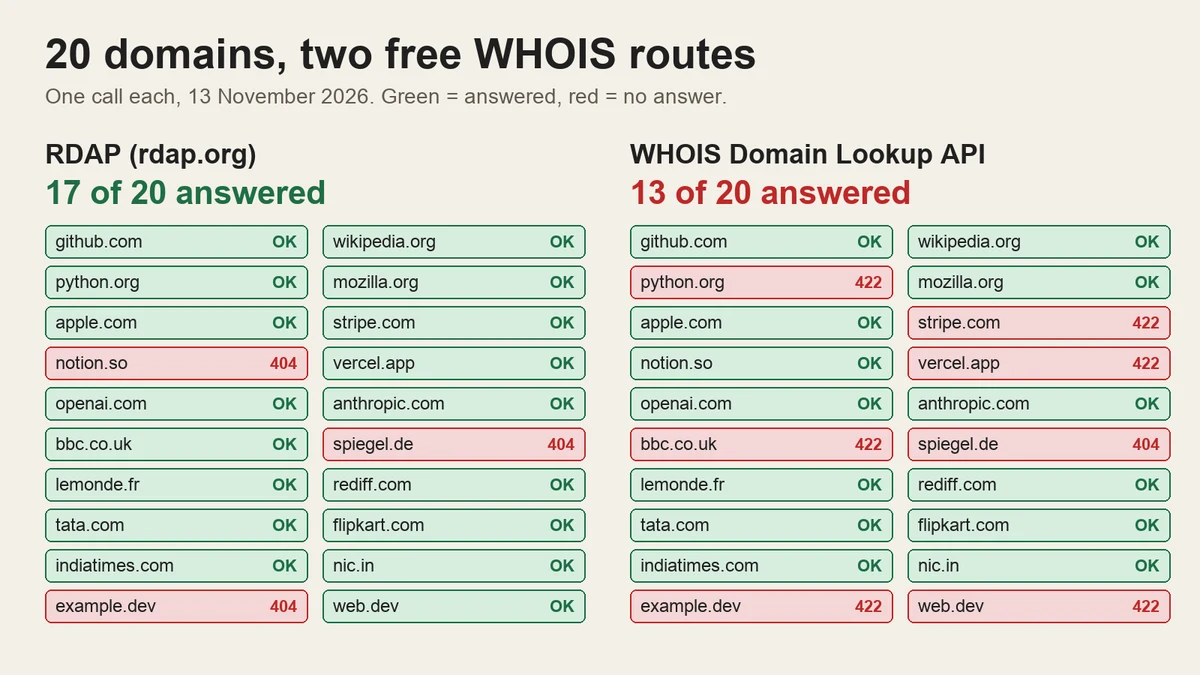
We picked 20 well-known domains across .com, .org, .net, .so, .dev, .app, .de, .fr, .in and .co.uk. For each we made one call to RDAP through rdap.org and one call to the WHOIS Domain Lookup API we run on APIHiver, from the same machine on 13 November 2026, one second apart.
| RDAP (rdap.org) | WHOIS Domain Lookup API | |
|---|---|---|
| Domains answered | 17 of 20 | 13 of 20 |
| Median time of the answers | 0.83 s | 0.74 s |
| Returned a 404 | 3 | 1 |
| Returned "extension not supported" | 0 | 6 |
Three findings stand out.
1. RDAP's three misses are explainable. notion.so and spiegel.de failed because .so and .de do not appear in IANA's RDAP bootstrap file, the list rdap.org uses to find the right server (we checked the file, last published 28 October 2026). example.dev is simply not a registered name. So RDAP failed only where no RDAP server is published.
2. The WHOIS API answered a domain RDAP could not. notion.so returned a full record from the WHOIS API. That is the real argument for using both: RDAP first, a WHOIS parser as the fallback. Who-dat, in the table above, is built on exactly that idea.
3. Our own API was the weaker one, and we want you to know why. It missed python.org, stripe.com, vercel.app, web.dev, bbc.co.uk and example.dev, and lemonde.fr came back with no creation date or name servers. We re-ran the misses and they failed again each time. The source it reads from returned an error for those names with no reason attached, and the API reported it as an unsupported extension, which is wrong for a .com. We list it in the table because it passed github.com, apple.com, openai.com and nine others, and because hiding a 13-of-20 result would make this comparison useless. We treat it as a beta until it handles those cases.
How to call RDAP in 10 lines#
RDAP needs no key. This Python function returns the fields most apps need. We ran it on 13 November 2026 and it returned the registrar, both dates, 8 name servers and 3 status codes for github.com, and None for notion.so.
import requests

def domain_info(domain):
    r = requests.get(f"https://rdap.org/domain/{domain}", timeout=15)
    if r.status_code == 404:
        return None  # unregistered, or the TLD has no RDAP server yet
    r.raise_for_status()
    data = r.json()
    events = {e["eventAction"]: e["eventDate"] for e in data.get("events", [])}
    registrar = next(
        (
            v[3]
            for e in data.get("entities", [])
            if "registrar" in e.get("roles", [])
            for v in e.get("vcardArray", [None, []])[1]
            if v[0] == "fn"
        ),
        None,
    )
    return {
        "domain": data["ldhName"],
        "registered": events.get("registration"),
        "expires": events.get("expiration"),
        "registrar": registrar,
        "name_servers": [n["ldhName"] for n in data.get("nameservers", [])],
        "status": data.get("status", []),
    }

print(domain_info("github.com"))
Or from the terminal: curl -L https://rdap.org/domain/github.com. The -L matters, because rdap.org answers with a redirect to the registry that holds the record.
Checklist before you pick one#
- Do you need personal contact data? Almost no free option will give it to you. Plan around dates, name servers and status codes.
- Which TLDs do you query? If you handle country domains such as
.deor.so, check coverage first. Our test shows RDAP alone leaves gaps. - How many lookups a month? A few hundred fit any free tier. Thousands need a paid plan or self-hosting.
- Do you cache? Registrars rate-limit lookups. ip-api.io says it caches each domain for 24 hours for that reason. Do the same.
- Is commercial use allowed? WhoisFreaks says yes for its free keys. Check the rest.
- What happens on a 404 or 429? Treat 404 as "maybe unregistered" and 429 as "retry later", not as errors.
Which one should you pick?#
| Your situation | Start with |
|---|---|
| A script, a side project, no signup | RDAP through rdap.org |
| Country domains RDAP cannot reach | Who-dat, or a vendor WHOIS API as a fallback |
| A few hundred lookups, JSON in one shape | WhoisFreaks or WHOIS XML API free credits |
| One account for WHOIS, DNS and more | APIFreaks |
| Full control and no quota | Self-host Who-dat |
| Try a WHOIS API on a marketplace | APIHiver WHOIS Domain Lookup, with the limits above in mind |
If you are building on APIs in general, our guides on API design principles and how to detect temporary emails cover other signals that pair well with domain age.
What we did not test#
- We called only two things ourselves: RDAP through rdap.org and the APIHiver WHOIS Domain Lookup API. WhoisFreaks, WHOIS XML API, APIFreaks, Who-dat, ip-api.io and the rest were not called by us. Their free limits come from their own pages.
- The test is 20 domains, one call each, from one machine. We did not measure accuracy against a registry's own record, only whether an answer came back and what was in it.
- We did not measure redaction rates. The point about hidden owner details comes from ICANN's guidance.
- Free allowances change often. Several of these pages were updated within the last week.
Sources#
- ICANN, ICANN Update: Launching RDAP; Sunsetting WHOIS (27 January 2025)
- ICANN, Registration Data Access Protocol (RDAP) overview
- IETF, RFC 9083: JSON Responses for the Registration Data Access Protocol
- IANA, RDAP DNS bootstrap file (published 28 October 2026)
- RDAP.org, bootstrap server documentation
- WhoisFreaks, Free WHOIS API page
- WhoisFreaks, How to use the WhoisFreaks API for domain lookups
- WHOIS XML API, WHOIS API product page and pricing
- APIFreaks, WHOIS API and pricing
- Who-dat, open-source project on GitHub
- ip-api.io, WHOIS lookup tool and developer API
- WhoAPI, WhoAPI introduces free domain API
- Omkar Cloud, Whois API
- Oanor, WHOIS API listing
- Shreshta, Whois API free
- FreePublicAPIs, Domain WHOIS API
- DEV Community, Free WHOIS and DNS lookup API
- Google Search, results for "whois api free" (13 November 2026)