You build a price tracker on SerpApi's Google Flights API. It works. Then the bill arrives and a quick check shows the same data is sold elsewhere for a fraction of the price.
That is the question this post answers. Google Flights has no public API, so SerpApi, SearchApi, HasData and the DataCrawler listing all read the same Google Flights results and sell them as JSON. The data is the same. What differs is what one search costs, how many requests a round trip needs, and what the plan limits are.
What we compared, and how#
We opened each provider's own pricing page on 18 November 2026 and wrote down every plan. The cost per 1,000 searches is a calculation, not a quote: plan price divided by the searches you actually use, on the cheapest plan that covers your volume. You pay for the whole plan even when you use part of it, so a plan that is too big raises the real price per search.
Two rules we kept:
- A "search" means one request that returns results. Providers count differently, which is why the round-trip section matters.
- We did not make live calls to every API. This is a pricing and plan comparison from public pages, not a speed or accuracy test. A short list of what we did not check is near the end.
Prices at a glance#
| Provider | Plan (all read 18 Nov 2026) | Included | Price per 1,000 at the plan's full size |
|---|---|---|---|
| SerpApi | Free $0 / Starter $25 / Developer $75 / Production $150 / Big Data $275 | 250 / 1,000 / 5,000 / 15,000 / 30,000 searches | $25.00 down to $9.17 |
| SearchApi | Developer $40 / Production $100 / BigData $250 / Scale $500 | 10,000 / 35,000 / 100,000 / 250,000 searches | $4.00 down to $2.00 |
| HasData (Google Flights API) | Free / Startup $49 / Basic $99 / Growth $208 | 67 / 13,333 / 66,667 / 200,000 requests | $3.69 down to $1.04 |
| DataCrawler (RapidAPI) | Basic $0 / Pro $12.99 / Ultra $35 / Mega $125 | 150 / 40,000 / 150,000 / 600,000 requests | $0.32 down to $0.21 |
| Duffel | Per order, no monthly plan | 1,500 searches per order free | $3.00 per order, $0.005 per search over the allowance |
HasData's page shows its plans as "billed annually, 2 months free", so a month-to-month price may be higher. DataCrawler's plans on RapidAPI also list a bandwidth fee of $0.001 per MB after 10,240 MB a month.
What you pay at four volumes#
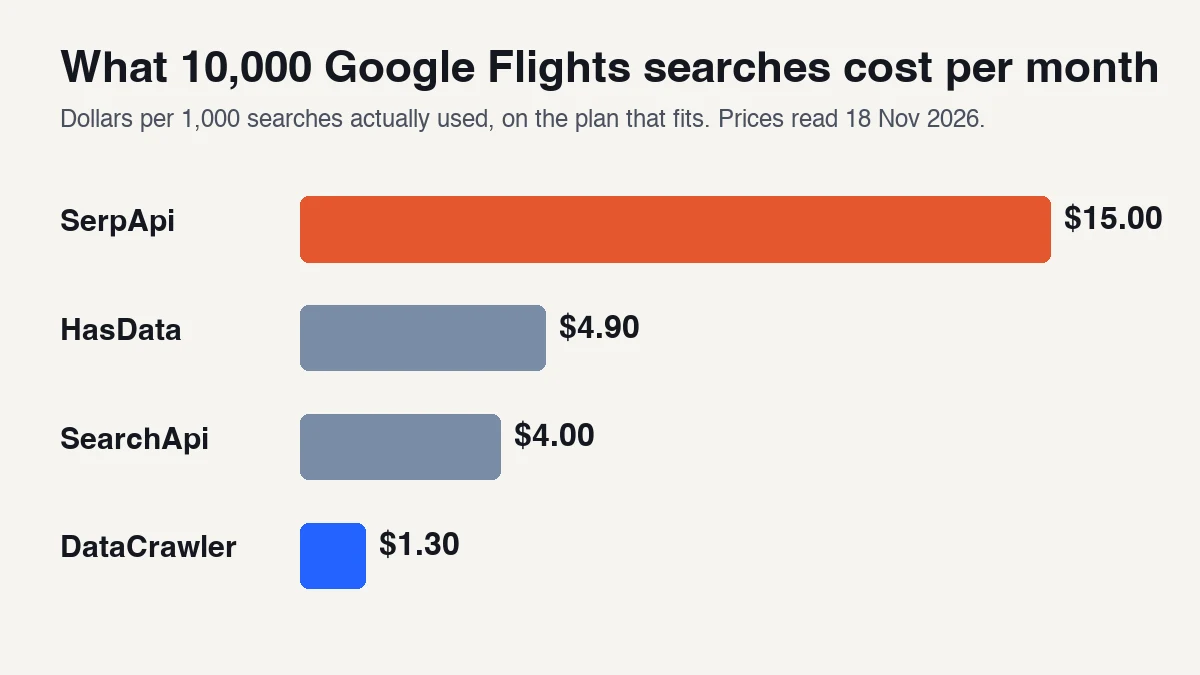
The price per 1,000 is only true when you fill the plan. This is what one month costs for 1,000, 3,000, 10,000 and 30,000 searches, on the smallest plan that covers each. The cost per 1,000 in brackets is based on the searches you actually use.
| Searches a month | SerpApi | SearchApi | HasData | DataCrawler |
|---|---|---|---|---|
| 1,000 | $25 ($25.00) | $40 ($40.00) | $49 ($49.00) | $12.99 ($12.99) |
| 3,000 | $75 ($25.00) | $40 ($13.33) | $49 ($16.33) | $12.99 ($4.33) |
| 10,000 | $150 ($15.00) | $40 ($4.00) | $49 ($4.90) | $12.99 ($1.30) |
| 30,000 | $275 ($9.17) | $100 ($3.33) | $99 ($3.30) | $12.99 ($0.43) |
Two things stand out.
- SerpApi only wins at the very bottom. Up to 250 searches a month its free plan costs nothing. At exactly 1,000 searches its $25 plan is cheaper than SearchApi's $40 and HasData's $49 (DataCrawler's $12.99 is still lower). Above that, the others pull ahead quickly.
- The DataCrawler column looks too good, so read the next section. It is counted in requests, and a request is not always a finished search.
The DataCrawler plans cap at 40,000, 150,000 and 600,000 requests, and the Pro plan's 40,000 covers every row above, which is why that column barely moves.
Why "per search" is not the same everywhere#
The cheapest number only helps if one request does one useful job.
SerpApi round trips use two requests. SerpApi's Google Flights documentation says that to get the returning flight for a round trip you make another request with a departure_token. A user who wants to see outbound and return options uses two searches. In the same table, 3,000 round trips with return flights on SerpApi is 6,000 requests, which pushes you from the $75 plan to the $150 plan, or $50.00 per 1,000 searches your users actually ran.
Other providers count differently. We read the DataCrawler, SearchApi and HasData pricing pages, but we did not confirm from their documentation how many requests a round trip with both legs needs. Before you commit, run one round-trip query on the free plan and count the requests.
Repeated queries. If your app asks for the same route many times, check each provider's terms on caching and repeat requests, which we did not verify.
The extras you pay for#
A higher price sometimes buys something real, based on what each pricing page lists:
- SerpApi: a "U.S. Legal Shield" listed on every plan. If your legal team asks who is responsible for the scraping, this is the answer they want.
- SearchApi: a 99.9% SLA on its plans, and a legal protection guarantee and team management from the Production plan up.
- HasData: one credit pool across several Google products (search, hotels, flights), so a team that also needs hotel data pays from one balance.
- DataCrawler: a hard cap on every plan except Mega, so a runaway loop stops instead of charging you. That protects your budget but also stops your app at the cap.
If none of those matters to you, price is the deciding factor.
When none of these is the right tool#
- You need to sell tickets. These APIs show fares and cannot book. Duffel is a booking API: $3.00 per confirmed order, with 1,500 searches per order free and $0.005 per search beyond that. We compare it with the other booking options in our flight booking API guide.
- You need flight status or live tracking. That is a different data set. Compare prices in flight status API pricing, or see free flight data APIs we tested.
- Your plan depends on Amadeus. Its Self-Service portal closed in July 2026. See what to use instead of Amadeus.
- You want the full picture of a travel app. Our best travel APIs guide covers flights, hotels, maps and reference data in one place.
A quick way to choose#
- Count your searches. Routes times dates times checks a day times 30.
- Run one round trip on a free plan and count how many requests it uses.
- Pick the plan that just covers the number, not the biggest one.
- Decide if you need the legal shield. If yes, SerpApi or SearchApi. If no, price decides.
- Re-check the prices. These are the pages as of 18 November 2026.
For a hands-on example with code, see our Google Flights API guide, which uses the DataCrawler listing with Node.js and Python.
What we did not test#
- We did not run live searches against SerpApi, SearchApi or HasData, so we have no speed or accuracy numbers for them.
- We did not confirm how many requests a round trip uses on SearchApi, HasData or DataCrawler.
- We did not read FlightAPI.io's credits-per-search, so it is not in the tables. Its pricing page lists a $49 plan with 30,000 credits.
- Prices are from public pricing pages on 18 November 2026. Taxes, overages and annual discounts may change what you pay.
Quick checklist#
- I know my searches per month
- I know how many requests one of my searches needs
- The plan I picked covers my volume without being much bigger
- I checked whether I need a legal shield or an SLA
- I read the provider's current pricing page, not this one
Related reading#
- Google Flights API: Get Live Data: step-by-step calls, code and the DataCrawler plans.
- Flight Booking API: 10 Famous Options Compared: when you need to issue tickets.
- Amadeus API Alternatives: what to use now that Self-Service has closed.
- Best Travel APIs for Developers in 2026: flights, hotels, maps and more.